
Rare Disease Month
- Morgan Bailey
- Mar 6
- 4 min read

February is Rare Disease Month, a time dedicated to raising awareness for conditions that individually affect small populations but collectively impact millions of families around the world.
For me, rare disease is not theoretical. It is not just a ribbon color or a statistic. It is personal.
It is living with an arteriovenous malformation, an AVM. It is surviving a rupture, a stroke, a craniotomy, and two rounds of Gamma Knife treatment. It is waking up in a hospital bed not knowing what the future will look like. It is rebuilding strength physically, emotionally, and mentally one slow and intentional step at a time.
Rare disease changed my life. It reshaped my plans, my body, and my identity. It also clarified something profound. If I survived, I wanted to use my voice.
This February, that voice brought me somewhere incredibly special.


I had the honor of traveling to Pennfield School in Rhode Island, a Pre-Kindergarten through 8th grade school where my best friend’s Dad serves as Head of School. Walking into that building, I was not entirely sure what to expect.
How do you explain something as complex as a brain AVM, stroke, and recovery to children? How do you talk about fear and healing in a way that is honest but not overwhelming?
What I found was something remarkable.
The students did not shy away from hard questions. They leaned into them.
They asked what it felt like when I could not walk. They asked if I was scared. They asked how long it took to use my hand again. They asked if I ever get frustrated now. They asked how they could help someone who might be going through something similar.
There was no awkwardness and no hesitation. Just curiosity rooted in compassion.
The younger students were wide-eyed and attentive. The middle schoolers asked nuanced and thoughtful questions about inclusion and invisible challenges. They were not just listening. They were trying to understand.



That is what Rare Disease Month is really about.
It is not just awareness. It is empathy. It is education. It is empowering the next generation to recognize that some battles are not visible, but they are very real.
I spoke about allyship and about how, sometimes, the greatest gift you can give someone facing a health challenge is consistency. I shared that when I was recovering, the most meaningful support was not dramatic gestures. It was the friends who stayed, like Galen. The people who treated me like Morgan first, and not my diagnosis, like my Mom. The ones who did not try to fix me but simply walked beside me.
I could see it connecting for them.
I even received a large envelope from one of the teachers. Inside were handwritten cards from the first graders.
Each one had taken the time to write me a note. Some had colorful drawings. Some had careful oversized letters. Some had misspellings that made the message even sweeter.
Over and over again I read the same words.
You are strong. You are brave. You are a warrior.
There is something deeply humbling about being called a warrior by a first grader. They were not using it as a metaphor, they meant it with their whole hearts.
I sat there holding those cards and thought about the girl I was in the Neuro-ICU. The one who could not walk. The one who could not move her right side. The one who did not know what her future would hold. If she could see this moment, speaking in a school, advocating during Rare Disease Month, receiving encouragement from children, she would not believe it.
Rare disease may be uncommon, but resilience is not.
The visit to Pennfield reminded me why I continue to share my story through Living With An AVM and through my book, Stroke Warrior. Not because I enjoy revisiting the hardest chapters of my life, but because those chapters can create connection, understanding, and hope.
These students did not see me as fragile. They saw me as someone who faced something hard and kept going.
That perspective matters.
If we can teach children early that inclusion means noticing the quiet struggles, that allyship means asking instead of assuming, and that invisible does not mean imaginary, then Rare Disease Month has done its job.
I left that school inspired. Not because I spoke but because they listened. Because they cared. Because they asked thoughtful questions and wanted to do better.
Those first-grade cards are tucked somewhere safe now. A reminder that even the smallest voices can carry powerful encouragement.
And on a personal note, I stayed with my best friend, Galen, and her family while I was in Rhode Island. Spending time with her was so special. Laughing, catching up, and sharing space with someone who has been a constant in my life made the trip even more meaningful. Those moments reminded me that connection and friendship are just as important as advocacy.

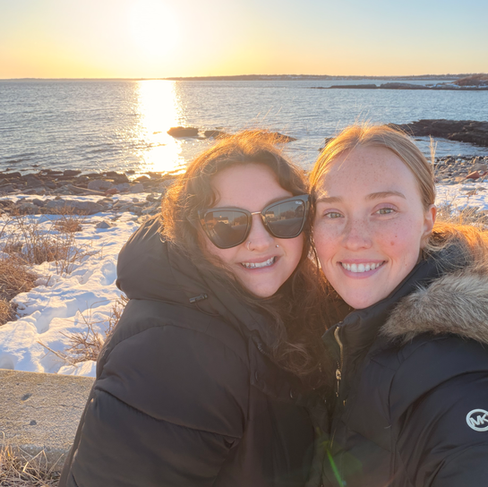


Rare disease changed my life. Moments like this remind me that purpose can grow from pain.
Alive on purpose.


Comments